Intermittent Hypoxia and Muscle Saturation
🫁📉
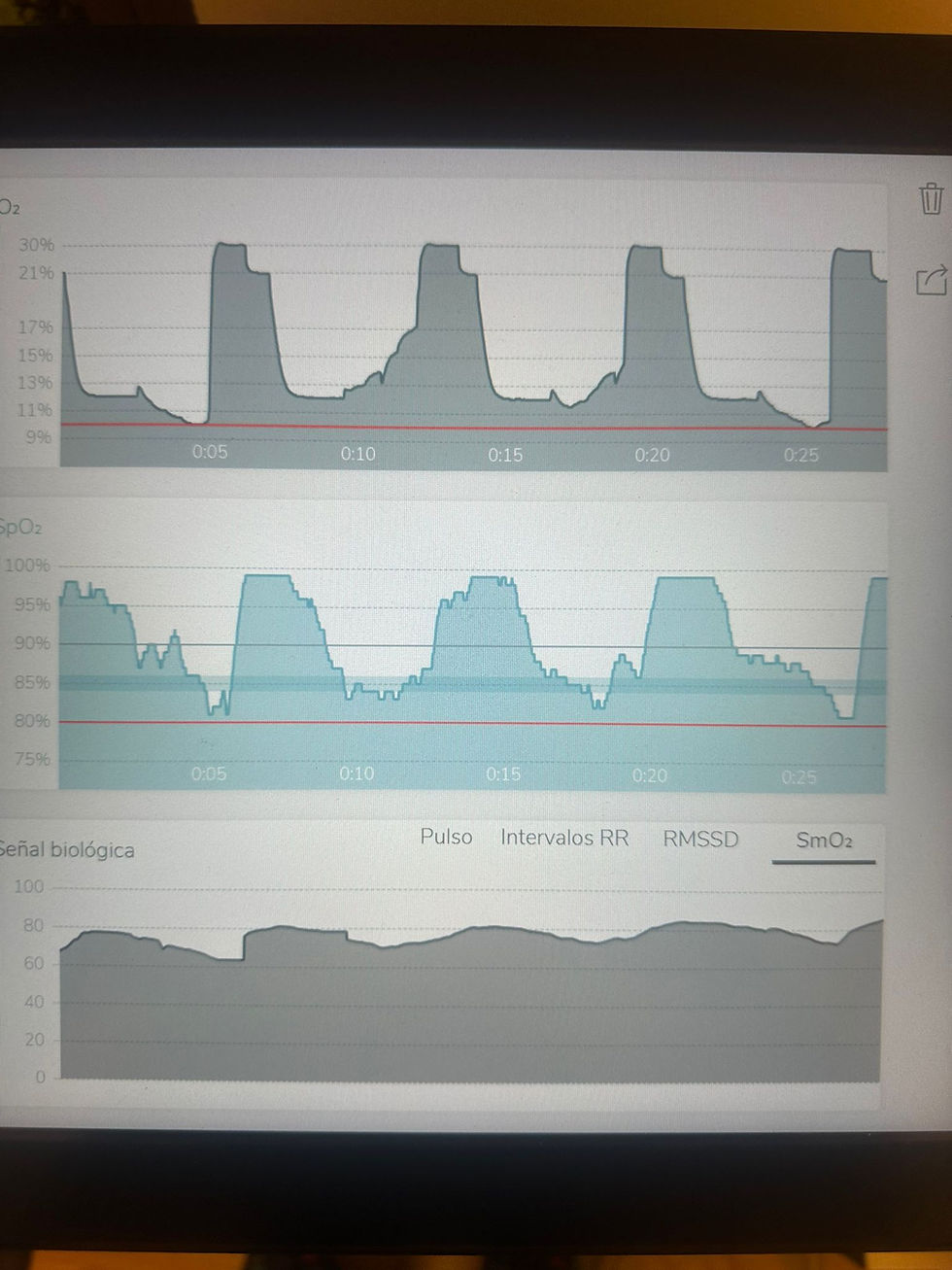
What happens in the muscle after 21 minutes of hypoxic stimulation?
Intermittent hypoxia not only modifies arterial oxygen saturation (SpO₂).
The real change occurs at the microvascular and muscular level, where the physiological adaptation that determines health, performance, and longevity takes place.
In this session we analyzed the evolution of SmO₂ (regional muscle saturation) during a protocol of repeated hypoxia-reoxygenation cycles.
—
📊 Objective Data from the Registry
🔹 Initial baseline SmO₂ value
• 66–69%
• Average value considered: ≈ 68%
🔹 Value after 21 minutes (3rd–4th complete cycle)
• Peak reoxygenation: 80–82%
• Average value considered: ≈ 81%
—
📈 Observed Increase
✅ Absolute increase
+13 percentage points
(81% – 68%)
✅ Relative increase
\frac{13}{68} \times 100 = 19 \%
🔬 Muscle saturation increased by approximately 19% compared to the initial baseline value.
—
🧬 What does this mean physiologically?
This increase is not an isolated fact. It is a sign of adaptation.
1️⃣ Progressive microvascular recruitment
Each cycle improves reactive muscle perfusion.
2️⃣ Improved post-hypoxia blood flow
A more efficient reactive hyperemia phenomenon occurs.
3️⃣ Activation of molecular mechanisms
• HIF-1α stimulation
• VEGF release
• Regulation of nitric oxide (eNOS)
• Improvement of peripheral vasodilation
4️⃣ Improved efficiency in oxygen redistribution
The muscle learns to:
• Extract better
• Redistribute better
• Reoxygenate faster
—
🫀 Key difference: SpO₂ vs SmO₂
While systemic SpO₂ decreases and increases according to the hypoxic cycle,
SmO₂ shows progressive adaptation cycle after cycle.
That indicates that the muscle:
• It not only tolerates the stimulus
• But it responds better each time
And that's real physiological training.
—
🧠 Why is this relevant to health?
Because properly dosed intermittent hypoxia can:
✔️ Improve endothelial function
✔️ Optimize microcirculation
✔️ Increase mitochondrial efficiency
✔️ Improve autonomic variability
✔️ Reduce systemic inflammation (when properly prescribed)
✔️ Promote vascular longevity
In patients with metabolic syndrome or low functional capacity, this type of response can make a real difference.
In athletes, it accelerates adaptive progression.
—
📌 Clinical Conclusion
After 21 minutes of intermittent hypoxia cycles:
🔹 SmO₂ increased by 13 absolute points
🔹 Represents a relative increase of 19%
🔹 The pattern is consistent with positive acute microvascular adaptation
🔹 Indicates good tolerance and room for progression
It's not just a drop in oxygen.
It is a controlled stimulus that teaches the muscle to function better.
And when the muscle improves its efficiency, the cardiovascular system does too.


